
Messaging platforms are creating new opportunities for businesses to deliver interactive digital experiences. For lottery platform operators, Telegram offers a way to connect with users through automated bots and browser-based Mini Apps without requiring every interaction to begin in a separate mobile application.
However, Telegram bots and Mini Apps serve different purposes. While bots are well suited to commands, notifications, and automated workflows, Mini Apps can provide richer interfaces for account management, campaign information, and interactive features.
Choosing the right approach to Telegram lottery software development requires evaluating the user experience, system architecture, integration requirements, security, and applicable regulatory obligations.
1. Understanding Telegram Bots for Lottery Platforms
A Telegram bot is an automated application that interacts with users through messages, commands, buttons, and supported menus. It can connect to backend services to retrieve information, process requests, and deliver notifications.
For a lottery platform, a bot may support several operational functions:
Sending draw schedules and published result updates
Answering frequently asked questions
Providing account-related notifications
Displaying campaign rules and eligibility information
Routing customer inquiries to support teams
Delivering administrative alerts to authorized staff
Bots can be relatively straightforward to introduce when the main requirement is communication or automation. Their capabilities still depend on backend integrations, access controls, and the workflows implemented by the development team.
A bot should not be treated as a complete lottery platform by itself. Account records, transaction processing, eligibility checks, and official result data generally require appropriately secured backend services.
2. What Telegram Mini Apps Add to the Experience
Telegram Mini Apps are web applications that open within the Telegram environment. They allow businesses to provide richer interfaces than a conventional message-based interaction.
Depending on the implementation, a Mini App can offer structured navigation, interactive dashboards, forms, campaign pages, and responsive layouts.
Potential applications include:
User dashboards with relevant account information
Draw schedules and historical result displays
Campaign details and eligibility requirements
Customer support interfaces
Administrative views for authorized personnel
Interactive informational experiences
For platform operators, Mini Apps can provide a more organized experience when users need to navigate several features rather than issue individual bot commands.
However, Mini Apps introduce additional development responsibilities, including frontend design, backend integration, performance optimization, and testing across supported devices.
3. Telegram Bots vs. Mini Apps: Key Differences
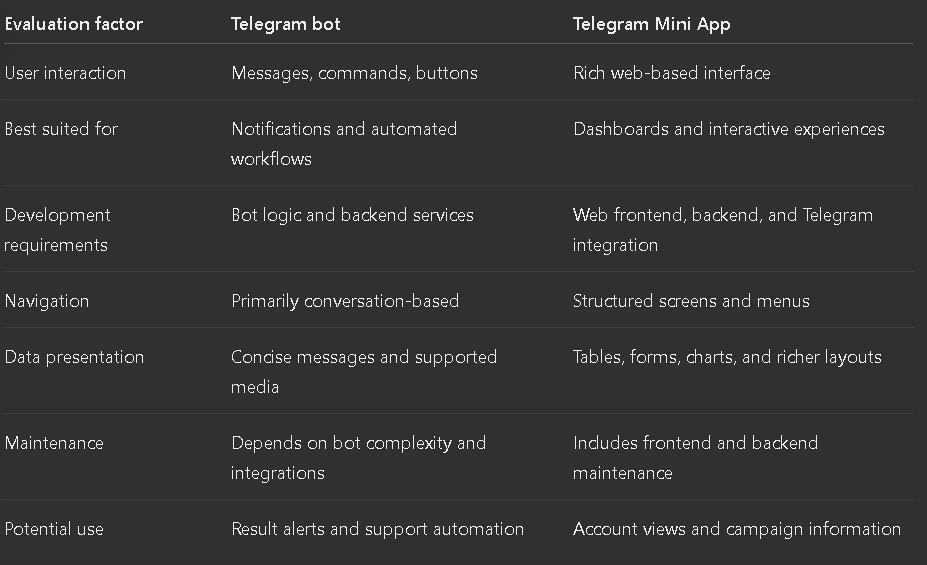
Neither option is automatically better. The appropriate choice depends on how users will interact with the platform and which functions need to be supported.
4. Evaluate the Backend Architecture Before Choosing
The most important architectural decision is often not whether to use a bot or Mini App, but how either interface connects to the underlying platform.
A scalable design should separate the presentation layer from core business logic. This allows developers to update the Telegram experience without unnecessarily changing account records, reporting systems, or other backend components.
A typical architecture may include:
Telegram interface → Authentication and API layer → Core platform services → Database and reporting systems
Depending on the product, supporting services may include notification processing, campaign management, account administration, and integrations with authorized external data providers.
A modular architecture can also make it easier to introduce a website or dedicated mobile application later without rebuilding every backend function.
Operators should evaluate API documentation, system monitoring, data consistency, backup procedures, and expected performance before selecting a development approach.
5. Prioritize Authentication and Data Security
Security should be part of the initial design rather than an afterthought.
Telegram Mini Apps provide initialization data that a backend can validate to help establish the authenticity of a launch request. The server should verify this data according to Telegram's documented requirements rather than trusting user identifiers or other values supplied by the frontend.
Additional safeguards should include:
Server-side authorization for sensitive actions
Secure session management and expiration
Rate limiting and abuse prevention
Encryption for data in transit
Access controls for administrative functions
Audit logs for important account and configuration changes
Bot tokens and other secrets must remain on the server and should never be exposed in client-side code.
If the platform handles personal information or financial transactions, operators should also assess data retention, privacy notices, incident response, and the applicable legal requirements for their intended markets.
6. Plan for Integrations and Future Scalability
A Telegram lottery experience may eventually need to connect with account management, customer relationship management, analytics, reporting, or other platform services.
A bot may be sufficient when the main requirements are simple notifications and automated responses. A Mini App may be more appropriate when users need to navigate multiple sections or interact with structured information.
A combined approach can also work well: the bot handles notifications and entry points, while the Mini App provides the interactive interface.
Before implementation, teams should define which system owns each data record, how events are synchronized, how errors are handled, and how integrations will be tested.
Scalability planning should consider expected concurrent users, notification volumes, API limits, database capacity, and recovery procedures. These factors help determine whether the architecture can support future growth.
7. Consider Compliance and Responsible Platform Design
Lottery-related products can be subject to significant legal restrictions. Requirements vary by jurisdiction and may depend on whether the product involves a regulated lottery, a promotional sweepstakes, or another type of gaming activity.
Operators should assess licensing, geographic eligibility, age restrictions, privacy obligations, promotional rules, and payment requirements where applicable.
The user interface should clearly explain relevant terms, eligibility conditions, and how published results are determined. If the platform supports regulated gaming, appropriate responsible-gambling safeguards and access restrictions may also be necessary.
Telegram's technical capabilities do not remove the operator's legal responsibilities. The product model and intended jurisdictions should be reviewed before launch.
8. How to Choose the Right Approach
Before committing to development, platform owners should answer three questions:
What do users need to accomplish? If the priority is receiving updates and checking simple information, a bot may be sufficient. If users need a multi-screen experience, a Mini App may be more suitable.
What systems must be integrated? Existing account services, reporting tools, and external APIs can influence the architecture and development effort.
How might the platform evolve? A modular backend and clearly defined APIs can make it easier to introduce new interfaces and capabilities over time.
A proof of concept can help validate usability, authentication, performance, and integration assumptions before a full rollout.
Conclusion
Telegram bots and Mini Apps offer complementary ways to deliver lottery-related digital experiences. Bots can simplify communication and automation, while Mini Apps provide a richer interface for structured interactions. For many projects, combining the two with a secure and modular backend may offer the most flexibility.
Businesses evaluating Telegram lottery software development should begin with their functional requirements, integration needs, security expectations, and compliance obligations rather than choosing a technology based on appearance alone.
TRUEiGTECH provides iGaming technology and software development solutions for businesses evaluating digital gaming platforms. A clearly defined architecture can help operators assess the right implementation strategy and build a foundation that supports future platform requirements.







Write a comment ...