
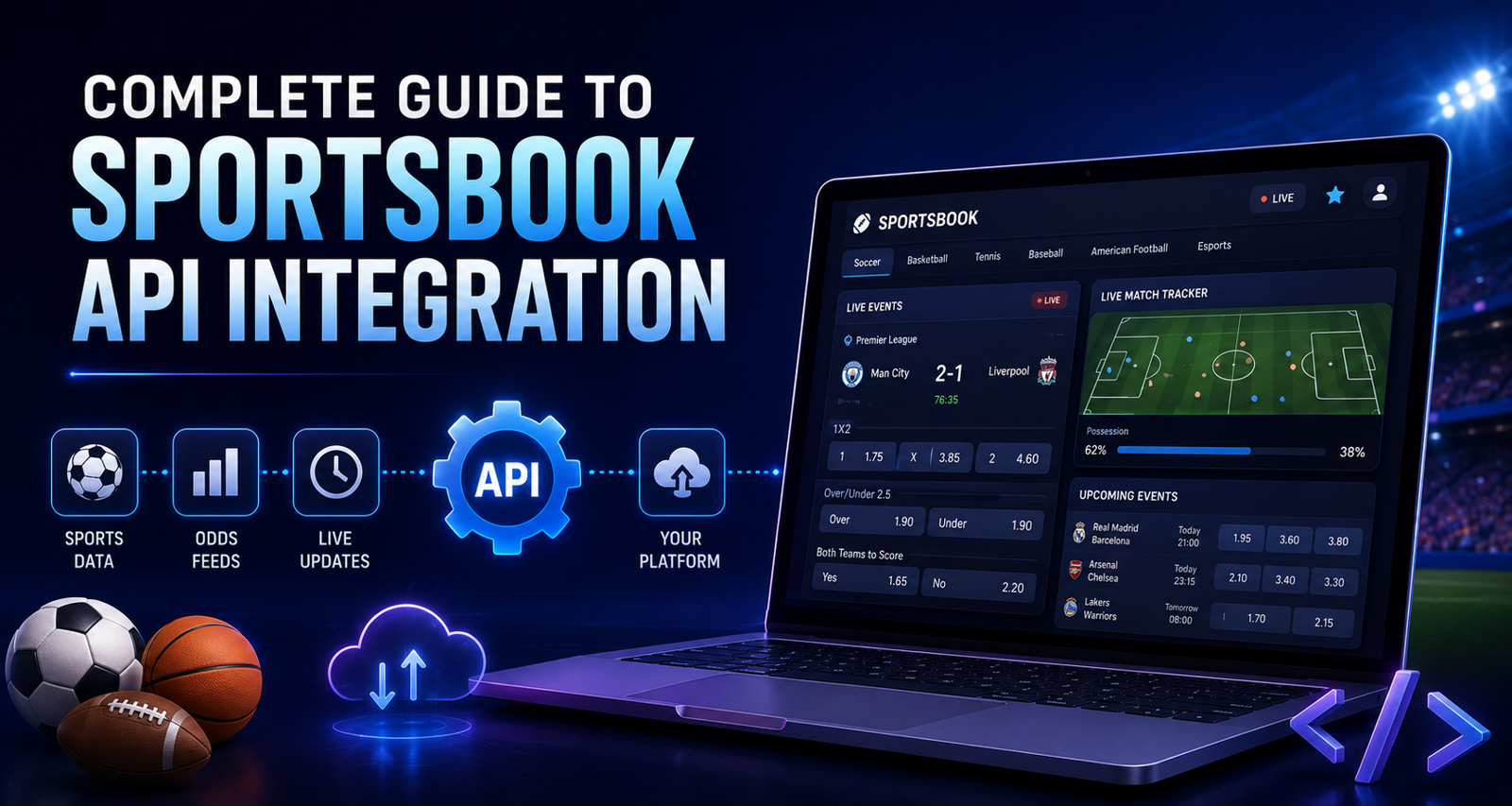
A modern sportsbook depends on multiple connected systems to deliver sports events, betting markets, odds, account functionality, transactions, and real-time updates. For operators building or expanding a betting platform, connecting these systems efficiently is a major technology consideration.
Sportsbook API integration allows operators to connect external services and data providers with their sportsbook infrastructure. This can help automate information exchange and support features that would otherwise require extensive in-house development.
However, integrating a sportsbook API is more than connecting one data source. Operators need to evaluate reliability, market coverage, latency, security, scalability, documentation, and compatibility with their existing platform.
What Is Sportsbook API Integration?
A sportsbook API is an application programming interface that allows different software systems to communicate with each other.
Depending on the provider, an API can deliver services such as sports data, fixtures, leagues, betting markets, odds, results, player information, and other sportsbook-related information.
The operator's platform can consume this information and present it through its own sportsbook interface.
Additional APIs may also be used for payments, user accounts, identity verification, notifications, analytics, and other services.
This makes API architecture a fundamental part of many modern sportsbook platforms.
Why Sportsbook APIs Matter
Developing every sportsbook component internally can require substantial technical resources.
API integrations can provide access to specialized functionality without requiring the operator to build every service from the beginning.
For example, an operator may integrate a sports data provider to receive event information while using separate services for payments and customer verification.
This modular approach can allow businesses to assemble a sportsbook technology stack around their specific operational requirements.
Key Considerations for Operators
Choosing an API provider should involve more than reviewing the number of available sports.
Operators should evaluate the complete integration environment before making a technology decision.
1. Sports and Market Coverage
The API should provide the sports, leagues, competitions, and markets relevant to the operator's target audience.
Coverage can include major international competitions as well as regional or niche events.
Businesses should also determine whether the provider supports pre-match markets, live betting markets, player props, statistics, and other required data.
A large catalog is useful only when it aligns with the operator's actual product requirements.
2. Real-Time Data and Odds Updates
Sportsbook users expect current information.
Odds, event status, scores, market availability, and other data can change quickly, particularly during live events.
The API should therefore deliver updates with appropriate frequency and reliability.
Operators should evaluate latency, update mechanisms, response times, and how the API handles high volumes of concurrent requests.
Real-time performance is especially important when the sportsbook supports live betting.
3. API Reliability and Uptime
An API is part of the sportsbook's operational infrastructure. If the external service becomes unavailable, dependent sportsbook features may also be affected.
Operators should examine the provider's reliability, monitoring capabilities, historical performance, and support processes.
Redundancy can also be considered for critical data services.
Where appropriate, backup sources or failover mechanisms can help reduce the impact of an unexpected provider outage.
4. API Documentation
Clear documentation can significantly simplify implementation and maintenance.
Operators and development teams should look for documentation covering:
Authentication
Endpoints
Request and response formats
Error codes
Rate limits
Webhooks
Data structures
Sandbox or testing environments
Versioning
Integration examples
Poor documentation can increase development time and make troubleshooting more difficult.
5. Authentication and Security
API integrations involve the movement of potentially sensitive information between systems.
Operators should review authentication methods, access controls, encryption requirements, credential management, and monitoring capabilities.
API credentials should be securely stored and rotated where appropriate.
The sportsbook should also validate incoming responses and apply appropriate controls against unauthorized requests or malformed data.
6. Data Synchronization
A sportsbook may receive information from multiple systems.
Event data, odds, account information, payment records, and settlement results may come from different services.
The platform therefore needs reliable synchronization mechanisms.
Developers should define how data is stored, updated, reconciled, and removed when information changes.
This is particularly important for live events where updates can arrive frequently.
7. Error Handling
External APIs can experience delays, incomplete responses, service interruptions, or data inconsistencies.
A robust sportsbook should not assume that every API request will succeed.
Error-handling mechanisms can include retries, timeout management, fallback logic, logging, alerts, and controlled handling of unavailable data.
These processes help prevent a temporary API issue from creating a wider platform problem.
8. Scalability
Sportsbook traffic can increase significantly during major sporting events.
The API integration architecture should be able to handle increased requests without causing unacceptable performance issues.
Operators should evaluate API rate limits, concurrency restrictions, server capacity, caching options, and infrastructure scalability.
The platform should also be tested under realistic peak-load conditions before major launches.
9. Webhooks and Event-Driven Updates
Some sportsbook APIs support webhooks that allow providers to push updates to the operator's system instead of requiring continuous polling.
This can be useful for receiving changes such as updated odds, event status, or other time-sensitive information.
An event-driven architecture can reduce unnecessary requests and improve the speed at which information reaches the sportsbook.
However, webhook delivery also needs monitoring, verification, retry handling, and appropriate security controls.
10. Integration With Existing Sportsbook Infrastructure
An API should fit the operator's current technology stack.
Businesses need to consider compatibility with their frontend, backend, database, account management system, payment services, and administrative tools.
For operators using an existing sportsbook platform or iframe-based solution, the API should also work effectively with the chosen integration architecture.
A technically capable API may still create unnecessary development effort if it requires extensive changes to the operator's existing system.
API Integration and Live Betting
Live betting creates additional demands on API infrastructure.
During a live sporting event, information can change within seconds. Odds may be updated, markets may be suspended, and event statuses may change based on what is happening on the field.
The sportsbook needs to process these updates quickly and present accurate information to users.
This means operators should evaluate API latency, update frequency, synchronization mechanisms, and the platform's ability to handle rapid changes.
API Integration for Payments and Other Services
Sports data is only one part of the sportsbook ecosystem.
Operators may also integrate APIs for:
Payment processing
Identity verification
Geolocation services
KYC workflows
Notifications
Customer relationship management
Analytics
Affiliate tracking
A modular API strategy can allow operators to select services based on their business requirements.
However, adding more integrations also increases the number of external dependencies. Monitoring and centralized integration management therefore become increasingly important.
Testing Before Launch
API integration should be tested across both normal and exceptional scenarios.
Development teams should test successful responses, invalid requests, delayed data, unavailable services, duplicate events, changing odds, incorrect data, and unexpected API responses.
Load testing can help identify performance limitations before a large number of users access the sportsbook.
Security testing is also important, particularly when APIs interact with user accounts, payments, or other sensitive systems.
Ongoing API Management
Integration is not complete when the initial connection goes live.
Operators should monitor API performance, response times, errors, data quality, and usage limits on an ongoing basis.
API versions can also change over time. A provider may introduce new endpoints, modify existing data structures, or retire older versions.
Businesses should therefore have a process for monitoring provider updates and maintaining compatibility.
Building a Flexible Sportsbook Technology Stack
The goal of sportsbook API integration should be to create a reliable connection between the operator's platform and the external services it depends on.
This requires careful planning around data flow, security, scalability, error handling, and system compatibility.
Operators should also avoid building the platform around unnecessary dependencies. Every external service should have a clear purpose within the overall architecture.
Final Thoughts
Sportsbook API integration can help operators access sports data and connect essential services without developing every component from scratch. However, the quality of the final sportsbook depends heavily on how those integrations are selected, implemented, monitored, and maintained.
Operators should evaluate API coverage, real-time performance, reliability, security, documentation, scalability, compatibility, and support before selecting a provider.
TIGSPORTSBOOK offers sportsbook technology solutions designed to support flexible integrations, real-time sports data, scalable infrastructure, and operator-focused sportsbook functionality.
A well-planned API architecture can provide the foundation for a sportsbook that remains reliable as the number of markets, users, events, and integrated services continues to grow.












Write a comment ...