
Prediction markets are rapidly becoming an important tool for businesses seeking better forecasting, improved decision-making, and enhanced user engagement. From enterprise forecasting and financial markets to sports, entertainment, and research, organizations are adopting prediction market platforms to harness collective intelligence and generate actionable insights.
While building a robust platform is essential, choosing the right revenue model is equally important. A well-planned monetization strategy helps businesses generate sustainable income while delivering value to users. The ideal model depends on factors such as target audience, industry, platform features, and long-term business objectives.
Whether you're launching a new platform or expanding an existing one, understanding different revenue models can help maximize profitability. This article explores the most effective revenue models for modern prediction market platforms.
Why Revenue Planning Matters
Many businesses focus primarily on software development and user acquisition, overlooking monetization during the planning stage.
A well-designed revenue model helps businesses:
Generate recurring income
Improve return on investment
Support platform growth
Fund future feature development
Increase business sustainability
Revenue planning should be integrated into the platform strategy from the beginning.
1. Subscription-Based Revenue
One of the most popular monetization models is a subscription plan.
Users pay a monthly or annual fee to access premium platform features.
Subscription benefits may include:
Advanced analytics
Premium prediction markets
Detailed forecasting reports
AI-powered insights
Priority customer support
Custom dashboards
This model provides predictable recurring revenue while encouraging long-term customer relationships.
2. Enterprise Licensing
Many organizations deploy prediction market platforms internally for strategic planning and forecasting.
Instead of charging individual users, providers license the platform to enterprises.
Enterprise licensing often includes:
Custom deployment
Dedicated infrastructure
User management
Administrative controls
Security enhancements
Ongoing technical support
This model generates high-value contracts and long-term partnerships.
3. Software-as-a-Service (SaaS)
A SaaS model enables businesses to deliver cloud-based prediction market platforms through recurring subscriptions.
Benefits include:
Lower upfront costs for customers
Continuous software updates
Automatic scalability
Flexible pricing tiers
Global accessibility
SaaS has become one of the most sustainable revenue models for software providers.
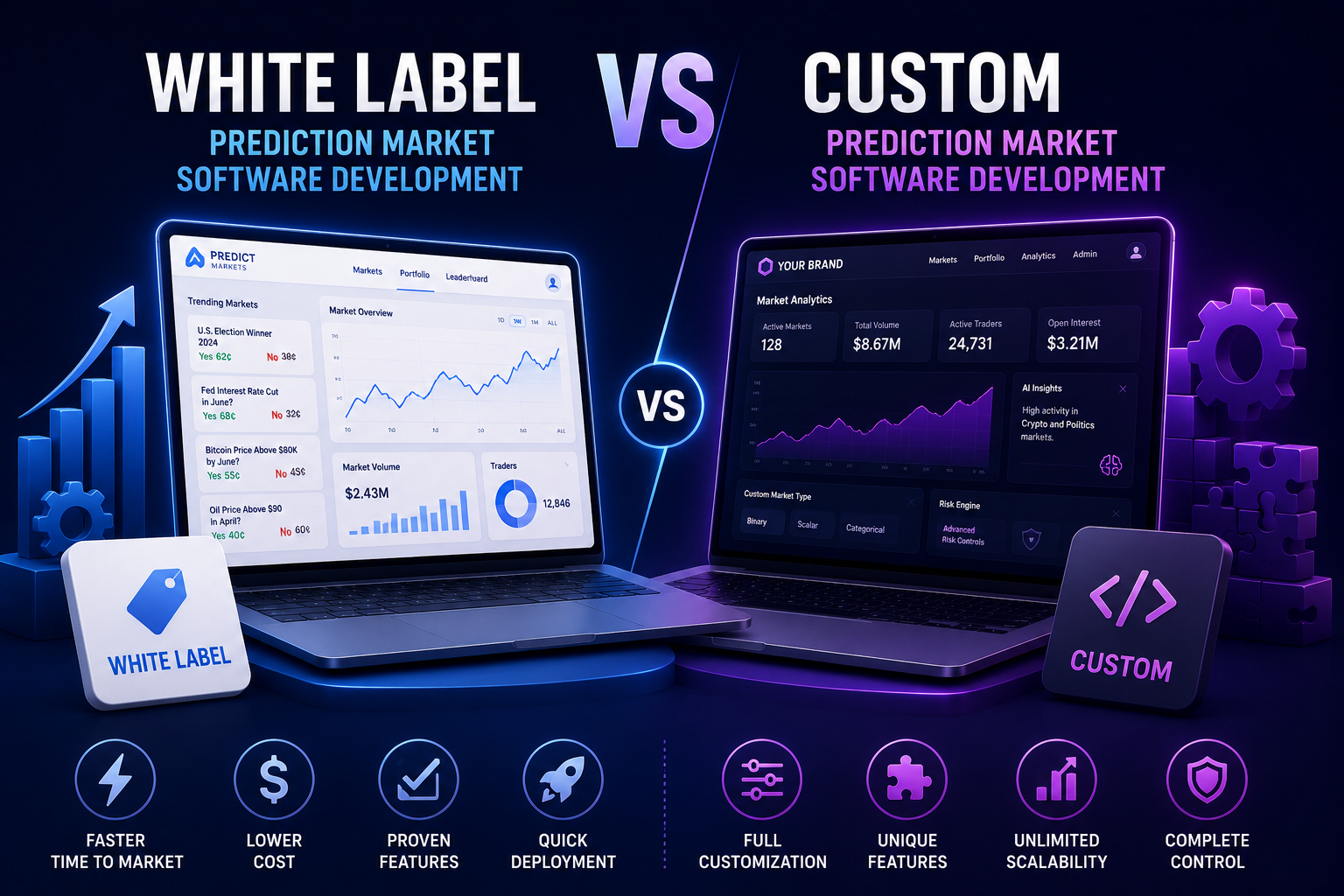
4. White Label Licensing
Businesses looking to enter the prediction market industry quickly often prefer white label solutions.
A prediction software provider can license a ready-made platform that customers rebrand as their own.
Revenue comes from:
Licensing fees
Customization services
Ongoing maintenance
Feature upgrades
Technical support
This model allows providers to serve multiple clients efficiently.
5. Custom Development Services
Many enterprises require tailored functionality that cannot be achieved through standard platforms.
Custom development generates revenue through:
Platform design
Feature development
API integration
Enterprise system integration
Performance optimization
Security implementation
Although project-based, custom development often leads to long-term support agreements.
6. Premium Analytics Services
Prediction markets generate valuable business intelligence.
Providers can monetize advanced analytics by offering:
Executive dashboards
Forecast reports
AI-generated insights
Market trend analysis
Predictive analytics
Performance benchmarking
Organizations often pay premium fees for deeper analytical capabilities.
7. API Access
Businesses may want to integrate prediction market data into their own applications.
Offering API access creates another recurring revenue stream.
API services can include:
Market data feeds
Forecast results
Historical datasets
Real-time updates
User analytics
Custom integrations
Tiered API pricing allows providers to serve startups and enterprises alike.
8. Consulting and Strategy Services
Many organizations need guidance beyond software development.
Consulting services may include:
Market strategy
Platform planning
Business consulting
Forecasting methodology
Digital transformation support
Professional services strengthen client relationships while generating additional revenue.
9. Training and Onboarding
Enterprise customers often require training to maximize platform adoption.
Training packages may include:
Administrator workshops
Employee onboarding
Documentation
Video tutorials
Technical training
Best practice guidance
Well-trained users are more likely to achieve successful outcomes and remain long-term customers.
10. Ongoing Maintenance and Support
Software requires continuous improvement after launch.
Support services typically include:
Security updates
Performance monitoring
Feature enhancements
Cloud management
Technical support
Infrastructure optimization
Maintenance contracts create recurring revenue while improving customer satisfaction.
Choosing the Right Revenue Model
Selecting the right monetization strategy depends on several factors:
Target Audience
Enterprise clients often prefer licensing or SaaS subscriptions, while startups may choose flexible pricing models.
Platform Complexity
Platforms with advanced AI, analytics, and enterprise integrations can justify premium pricing.
Business Goals
Companies seeking recurring income typically prioritize subscription and SaaS models over one-time project fees.
Market Position
A combination of licensing, custom development, consulting, and ongoing support often delivers the strongest long-term profitability.
Combining Multiple Revenue Streams
Many successful providers combine several revenue models rather than relying on a single source of income.
For example, a business might offer:
SaaS subscriptions
Enterprise licensing
Custom development
API access
Consulting
Maintenance services
Diversifying revenue streams creates greater financial stability and reduces business risk.
Future Revenue Opportunities
As AI and predictive analytics continue to evolve, new monetization opportunities are emerging.
Future revenue models may include:
AI-powered forecasting subscriptions
Predictive analytics services
Industry-specific forecasting solutions
Premium collaboration tools
Advanced reporting packages
Marketplace integrations
Businesses that adapt to changing customer needs will be better positioned for long-term growth.
Conclusion
A successful prediction market platform requires more than advanced technology—it also needs a sustainable monetization strategy. Revenue models such as SaaS subscriptions, enterprise licensing, white label solutions, custom development, API services, premium analytics, and ongoing support enable businesses to generate recurring income while delivering exceptional value to customers.
Organizations planning to build or scale prediction market platforms should evaluate revenue strategies early in the development process to maximize long-term profitability. Working with an experienced prediction software provider ensures the platform is designed with scalability, flexibility, and future growth in mind.
At TRUEiGTECH, we specialize in developing intelligent and scalable prediction market platforms that support a wide range of business models and revenue strategies. As a trusted prediction software provider, we help startups and enterprises build secure, feature-rich solutions that drive innovation, increase user engagement, and create sustainable long-term business success.






Write a comment ...